Journey Into a World of Orchids
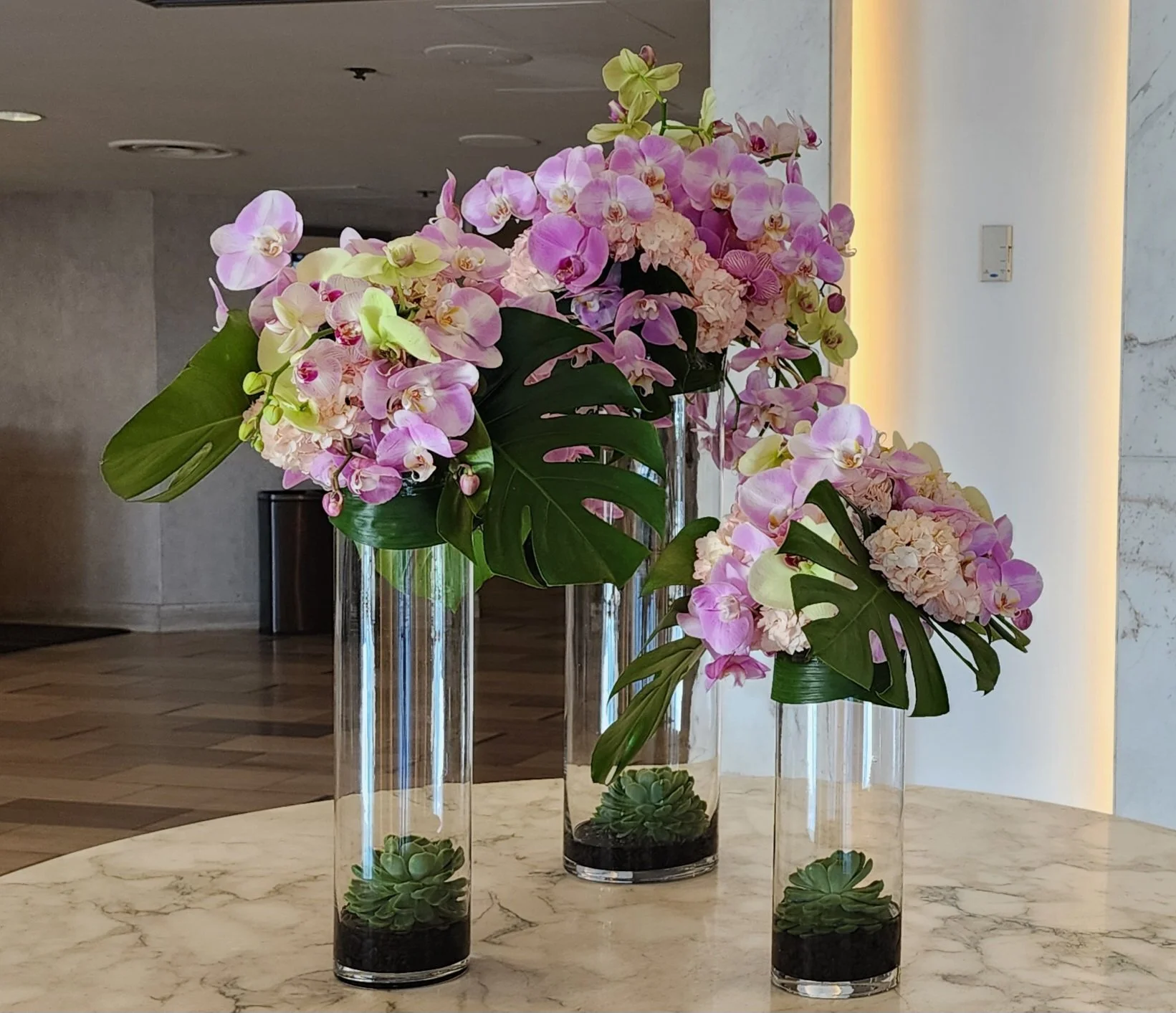
Fresh orchids with hydrangeas in tall glass vessels with succulent on the base nestled on black pebbles.
Written by Janet Chu (Orchid Designer)
Before I ever stepped into orchid design myself, I watched from a distance as Ada, the owner of Orchid Boutique, shaped orchids into something architectural and intentional. At the time, I didn’t imagine myself doing the same work, but the influence stayed with me, shaping the way I understood form and balance.
My deeper journey into floral design began during a period of upheaval. Although my home was spared, the night of the Eaton Fire—and the disruption that followed—lingered far beyond that evening. My family and I were unable to return home for several months due to ash and soot, and power was restored only after a long pause. Yet that time became an unexpected reset. It slowed everything down and shifted my focus toward rebuilding with care and intention. During that time, I found myself drawn to working with living materials as an art form, choosing renewal and growth as a way forward.
Orchids became that focus. Designing with orchids offered structure and calm, a way to channel energy into something living and responsive.
I started with small arrangements, learning the mechanics first—how orchids sit in a pot, how weight and proportion affect the overall form. As I moved into medium and then larger vessels, the lessons became more complex. One large arrangement stands out clearly in my memory. The pot itself was 18” tall with a 13” diameter, yet the orchids were placed on a single plane, making the entire piece feel visually compressed. The issue wasn’t the container—it was the composition.
That realization pushed me to experiment with elevation and layering. Instead of placing everything at one level, I began allowing orchids to rise and recede within the same arrangement. That shift transformed how the work read as a whole. The pieces became dimensional rather than static, with movement and depth guiding the eye.
My background in film naturally wove its way into the process. Lighting and photography refined how I evaluated the work. I noticed how traditional wooden stakes, while functional, interrupted the visual integrity of an arrangement. Replacing them with crystal rods changed how light traveled through the piece and how the orchids translated on camera.
During the pandemic, I began exploring jewelry making, and that practice carried over into my floral work. Wiring became another design tool rather than a necessity. I experimented with different wire colors, subtle jewelry-inspired coils, and later incorporated pearls, chains, and beads—not as embellishments, but as restrained accents that elevated the composition without overwhelming it.
Each photograph became a study. Seeing the arrangements frozen in time clarified what worked, what didn’t, and what needed editing. Color relationships became more intentional. Excess was removed. Over time, I learned to trust my eye rather than overcompensate.
Orchid design eventually became a rhythm—measured, studied, and deeply connected to growth. What began as a response to life’s challenges evolved into a disciplined practice rooted in observation, refinement, and respect for form. Orchids are not simply decorative objects; they are living, breathing entities that respond to care and environment. Given space, light, balance, and patience, they thrive. Pushed too hard or neglected, they falter.
In many ways, orchids mirror life itself. When treated with intention and allowed to grow at their own pace, they offer resilience, beauty, and quiet strength—qualities I continue to learn from with every arrangement.
